(৭)গণতন্ত্র সূচক- Democracy Index
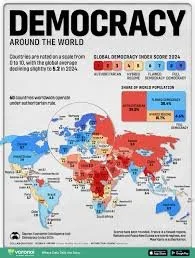
The Measurement of Democracy Index
The Economist Intelligence Unit (EIU) Democracy Index is a comprehensive framework that evaluates the state of democracy in 167 countries and territories. Unlike simpler metrics that focus solely on the presence of elections, the EIU methodology incorporates the broader health of political institutions and culture.
Here is a detailed breakdown of how the index is measured:
1. The Core Framework: Five Categories
The index is built upon 60 indicators, which are grouped into five primary categories. Each category represents a different dimension of a democratic society:
Electoral Process and Pluralism: Focuses on the freedom and fairness of national elections, the right of citizens to form political parties, and the ability of the opposition to gain power.
Functioning of Government: Examines whether the freely elected government determines policy, the extent of transparency, and the absence of corruption.
Political Participation: Measures voter turnout, the percentage of women in parliament, and the level of engagement by citizens in political parties or non-governmental organizations.
Political Culture: Assesses the degree of popular support for democracy versus alternative systems (like military or authoritarian rule) and the consensus on democratic norms.
Civil Liberties: Evaluates freedom of expression, freedom of religion, the right to a fair trial, and the protection of minority rights.
2. Scoring Methodology
The scoring process follows a structured hierarchy to ensure a quantitative result:
Indicator Scoring: Each of the 60 questions has set answers, typically scored as 0, 0.5, or 1. These scores are based on expert assessments and, significantly, results from public opinion surveys (such as the World Values Survey).
Category Scores: Within each category, the indicator scores are summed, multiplied by 10, and divided by the total number of indicators in that category. This results in a score from 0 to 10 for each of the five categories.
Final Index Calculation: The overall Democracy Index is the simple average of the five category scores.
Deductions (The "Veto" Rules): There are specific "modifying dependencies." For example, if a country’s national elections are not considered free and fair, it receives a significant deduction in its "Functioning of Government" score, as a lack of electoral legitimacy undermines the entire democratic structure.
3. Classification of Regimes
Based on the final score (rounded to two decimal places), the EIU classifies countries into four types of regimes:
| Regime Type | Score Range | Description |
|---|---|---|
| Full Democracy | $8.01 - 10.0$ | Civil liberties and fundamental political freedoms are respected and reinforced by a political culture conducive to democracy. |
| Flawed Democracy | $6.01 - 8.0$ | Elections are fair and basic liberties are respected, but there are significant weaknesses in other aspects (e.g., low political participation). |
| Hybrid Regime | $4.01 - 6.0$ | Elections have substantial irregularities that often prevent them from being both free and fair. Governance is weak and the judiciary is not independent. |
| Authoritarian Regime | $0.0 - 4.0$ | Political pluralism is absent or heavily restricted. Infringements on civil liberties are common, and the media is typically state-controlled. |
4. Distinguishing Features
The EIU Index is noted for two specific methodological choices:
Emphasis on Public Opinion: Unlike other indices that rely solely on legal documents or expert panels, the EIU incorporates survey data to see if the citizens actually value democracy.
Breadth over Economics: The index focuses strictly on political and social factors. It does not include economic growth or living standards as criteria, arguing that a wealthy country is not inherently more democratic than a poor one.
Three Ways to Frame and Measure Democracy
Examples of how democracy is framed and measured:
| Index | Freedom House | Economist Intelligence Unit | V-Dem |
|---|---|---|---|
| Components | Elections | Elections | Elections |
| Participation | Participation | Participation | |
| Functioning of Government | Functioning of Government | Deliberation | |
| Free Expression | Political Culture | Egalitarianism | |
| Organizational Rights | Civil Liberties | Liberalism (individual rights) | |
| Rule of Law | |||
| Individual Rights |
Bangladesh Democracy Index Scores (2020–2024):
Based on the latest data from the Economist Intelligence Unit (EIU), Bangladesh’s performance in the Democracy Index has seen a notable shift recently, moving from a "Hybrid Regime" toward "Authoritarian" territory in the 2024 report.
The following table breaks down the scores across all five categories for the last five reports (2020–2024).
| Category | 2024 | 2023 | 2022 | 2021 | 2020 |
|---|---|---|---|---|---|
| I. Electoral process and pluralism | 6.08 | 7.42 | 7.42 | 7.42 | 7.42 |
| II. Functioning of government | 2.57 | 6.07 | 6.07 | 6.07 | 5.07 |
| III. Political participation | 5.00 | 5.56 | 5.56 | 5.56 | 6.11 |
| IV. Political culture | 5.00 | 5.63 | 5.63 | 5.63 | 5.63 |
| V. Civil liberties | 3.53 | 4.71 | 4.71 | 5.29 | 5.29 |
| Overall Score | 4.44 | 5.87 | 5.99 | 5.99 | 5.99 |
| Regime Type | Authoritarian | Hybrid | Hybrid | Hybrid | Hybrid |
Democracy Index 2025: SAARC Countries:
Based on the EIU Democracy Index 2025 (released in April 2026), the SAARC region continues to reflect a broad spectrum of political systems, ranging from "Flawed Democracies" to "Authoritarian Regimes."
The following table summarizes the performance of SAARC nations in the most recent report.
| SAARC Country | Global Rank | Overall Score | Regime Type |
|---|---|---|---|
| India | 41 | 6.32 | Flawed Democracy |
| Sri Lanka | 68 | 5.85 | Hybrid Regime |
| Bhutan | 82 | 5.44 | Hybrid Regime |
| Nepal | 104 | 4.31 | Hybrid Regime |
| Bangladesh | 108 | 4.12 | Authoritarian Regime* |
| Pakistan | 124 | 3.84 | Authoritarian Regime |
| Afghanistan | 167 | 0.26 | Authoritarian Regime |
| Maldives | N/A | N/A | Limited EIU Data |
Measuring Democracy: Research Article
Visit the Page : Political Nuances: The Essentials of strategic Leadership.
১) গণতন্ত্র সূচকঃ বাংলাদেশের স্কোর ও র্যাঙ্কিং (১৪) - লিংক
২) গণতন্ত্র ম্যাপিং- বৈশ্বিক অবস্থা (১৫) - লিংক
৩) গণতন্ত্র সূচকঃ ০৩ বছরে ০৫টি মানদন্ডে বাংলাদেশের স্বতন্ত্র স্কোর এবং ৬০টি প্রশ্ন (১৬) - লিংক
৪) গণতন্ত্র সূচক ২০২৪ঃ মুসলিম বিশ্বের অবস্থান বিশ্লেষণ (১৩) - লিংক
