25. Democratization: Process and Theories.
Understanding Democratization
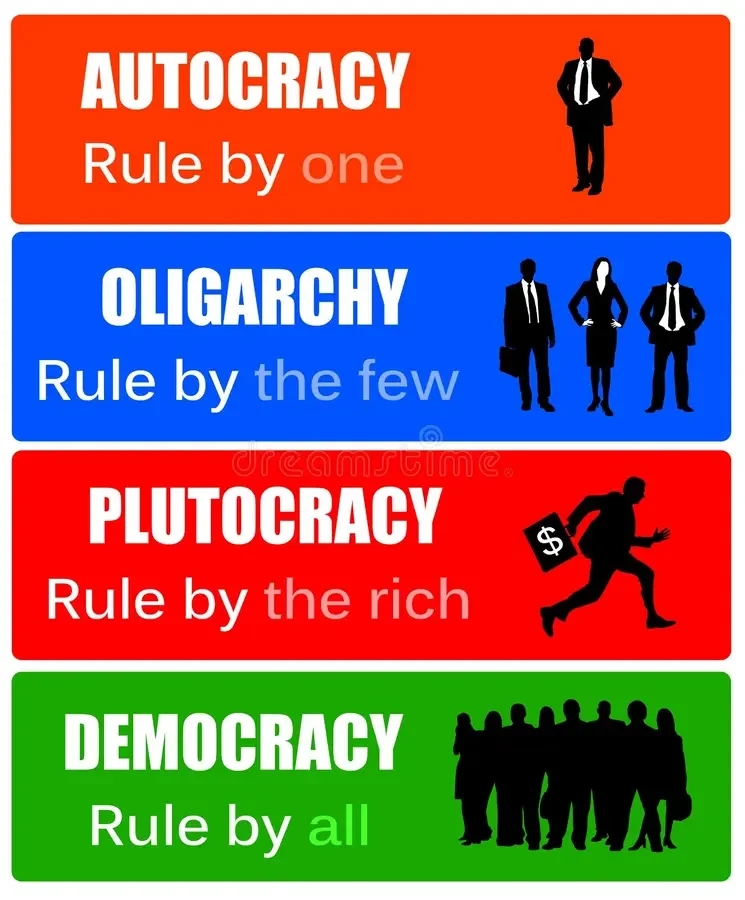
Democratization is the process through which a political regime moves from an authoritarian system toward a democratic one. It is rarely a linear path and involves the transition from autocratic rule to a government characterized by free and fair elections, the protection of civil liberties, and the rule of law.
Process:
This process often occurs in stages:
Liberalization: The opening of some political space (e.g., easing of censorship).
Transition: The collapse or reform of the old regime and the establishment of new democratic institutions.
Consolidation: The point where democracy becomes "the only game in town," meaning all political actors accept democratic rules.
2.Key Theories of Democratization:
Political scientists have developed several frameworks to explain why and how countries democratize.
2.1 Modernization Theory
This theory suggests that economic development leads to social changes that eventually produce democracy. As a country becomes wealthier, it develops a larger middle class, higher literacy rates, and more urbanized populations, all of which demand political participation.
Key Figure: Seymour Martin Lipset, who famously argued that "the more well-to-do a nation, the greater the chances that it will sustain democracy."
2.2 Structural/Class-Based Theory
This approach focuses on the balance of power between different social classes. It argues that democratization occurs when the power of the landed aristocracy is broken and the working or middle classes gain enough leverage to demand rights.
Key Figure: Barrington Moore, who noted, "No bourgeois, no democracy."
2.3 Institutionalism
Institutionalists focus on the design of political systems—such as constitutions, electoral rules, and the balance of power between branches of government. They argue that the right set of "rules of the game" can incentivize democratic behavior even in fractured societies.
Key Figure: Arend Lijphart, known for his work on "Consociational Democracy."
2.4 Transition (Agency) Theory
This theory emphasizes the role of specific leaders and the "pacts" or negotiations they make. It suggests that democratization is often the result of strategic choices made by "soft-liners" within an authoritarian regime and "moderates" in the opposition.
Key Figures: Guillermo O'Donnell and Philippe Schmitter.
3.Influential Political Scientists in Democratic Transition:
Several scholars are foundational to the study of how countries shift from autocracy to democracy:
3.1 Samuel P. Huntington
In his book The Third Wave, Huntington described the global trend of democratization that began in the 1970s. He identified three distinct "waves" of democracy throughout history and analyzed the factors that triggered the most recent surge, such as economic growth and changes in the Catholic Church.
3.2 Robert Dahl
While he focused more on the definition of democracy, his concept of "Polyarchy" is essential for understanding transitions. He argued that democracy requires two dimensions: Inclusion (the right to participate) and Contestation (the right to compete for power).
3.3 Daron Acemoglu and James A. Robinson
In Economic Origins of Dictatorship and Democracy, they use a rational-choice framework. They argue that elites concede to democracy when the threat of revolution is high and the cost of repression is even higher. Democracy acts as a "credible commitment" to redistribute wealth in the future.
3.4 Francis Fukuyama
Following the collapse of the Soviet Union, Fukuyama wrote The End of History and the Last Man. He suggested that liberal democracy might constitute the "end point of mankind's ideological evolution," though he has since written extensively on the difficulties of building the state institutions necessary to support those democracies.
3.5 Adam Przeworski
Przeworski is famous for his empirical research on the survival of democracies. He argues that while economic development might not cause a transition to democracy, it is the single best predictor of whether a democracy will survive once it is established.
